Flowers Among the Rocks. On the Charism of the Crusade for the Liberation of Man Beyond Poland
Written for the quarterly „Eleuteria", no. 3/2026. Translated from the Polish original: Kwiaty wśród skał.
For the past few months an image has stayed with me — one that appeared during my private retreat on the ancient island of Iona, home of the great saints of Celtic Christianity. Walking along a rocky cliff falling into the ocean, I saw among the stones a single small flower, breaking through them alone. A few hundred metres inland there were thousands of such flowers; this one stood by itself. I asked myself: does this flower grow here according to nature — or against it?
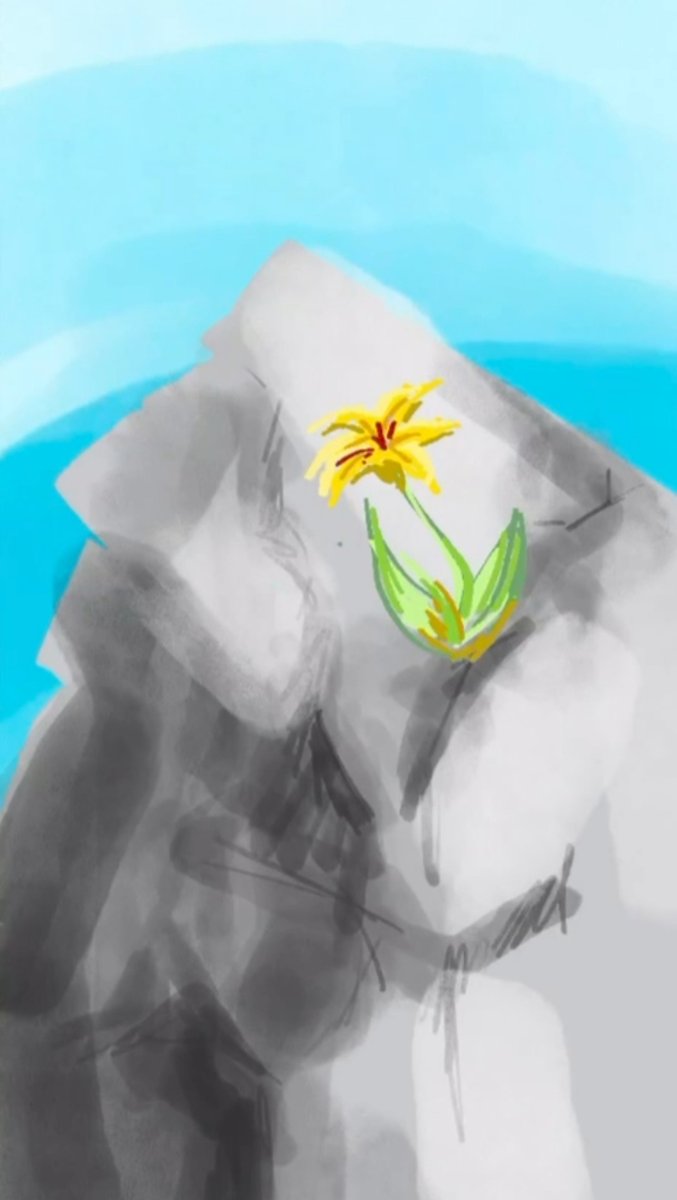
Illustration: Zuzanna Rataj
It is also a good opening image for reflecting on the presence of the Crusade for the Liberation of Man (KWC) beyond the borders of Poland. In its origins and founding assumptions, the Crusade was meant to be a mass movement embracing multitudes. This is not the place to consider how far that has been realised, or whether at the present stage the work should hold on to that original "numerical" assumption as the essence of its endurance.
One thing, however, is certain: the growth and "sowing" of the charism the Crusade carries beyond Poland happens without that original, founding vision of the masses — and yet the Spirit keeps calling new people who discover in this call a beauty and a strength for their own lives.
I learned these ways of the Spirit myself in Ireland. After a few years of the Light-Life Movement's growth on the island, a vision arose of establishing a prayer diakonia, which quite quickly found a home for a time in our Divine Word house. What a surprise it was when, practically month after month, someone would arrive at a diakonia meeting — its "script" of prayer and teaching prepared well in advance, some travelling truly great distances — and say that today they wished to make the KWC declaration. And this did not mean the person was connected with the Movement at all. The script had to be rebuilt on the spot to make room for a small KWC liturgy with the sign of the declaration made before the community. These were not coincidences — they were inspirations of the Spirit, showing that He calls particular people to this work. He knows why He gathers His chosen ones, even when we do not yet understand.
The experience of the Crusade abroad lets us notice an aspect that in Poland may remain invisible. For very many people engaged in the KWC in Poland it seems to be one additional dimension of being in the Church, alongside other belongings. In Ireland I have met people who joined because they wanted the experience of belonging to a community — a community which, though united by the one common sign of prayer and abstinence, does not fill their everyday life with events, meetings and obligations, and yet gives the sense that one is not alone.
These small groups, even single persons — like flowers among the rocks — perhaps help us see the "details" of the work more clearly, or even discover new dimensions of it. They certainly help in updating this charism of liberation, and they teach that it must be continually contextualised. In Ireland, for instance, we have our own Irish patrons of the work — among them a saintly bishop and abstainer, St Oliver Plunkett — while the KWC in Canada gathers around the Canadian Martyrs.
In a certain sense these small communities may become the leaven of a new language for our Work. Much of the original vocabulary and expression is simply unreadable in other cultures — which does not mean, as I have indicated above, that the Work itself has no reason to exist there.
May these small "flowers of liberation", which the Spirit sows throughout the world, be for us a joy — and a call to a constant answer of love, given together with the Immaculate at the foot of the Cross of Christ.
Fr Bart Parys, SVD